

Solar Battery Rebate: How It Works for Perth Homes
The federal program takes around 30% off an eligible battery, applied as a discount on your quote. The rate drops on 1 January 2027.
Last checked: 29 October 2026
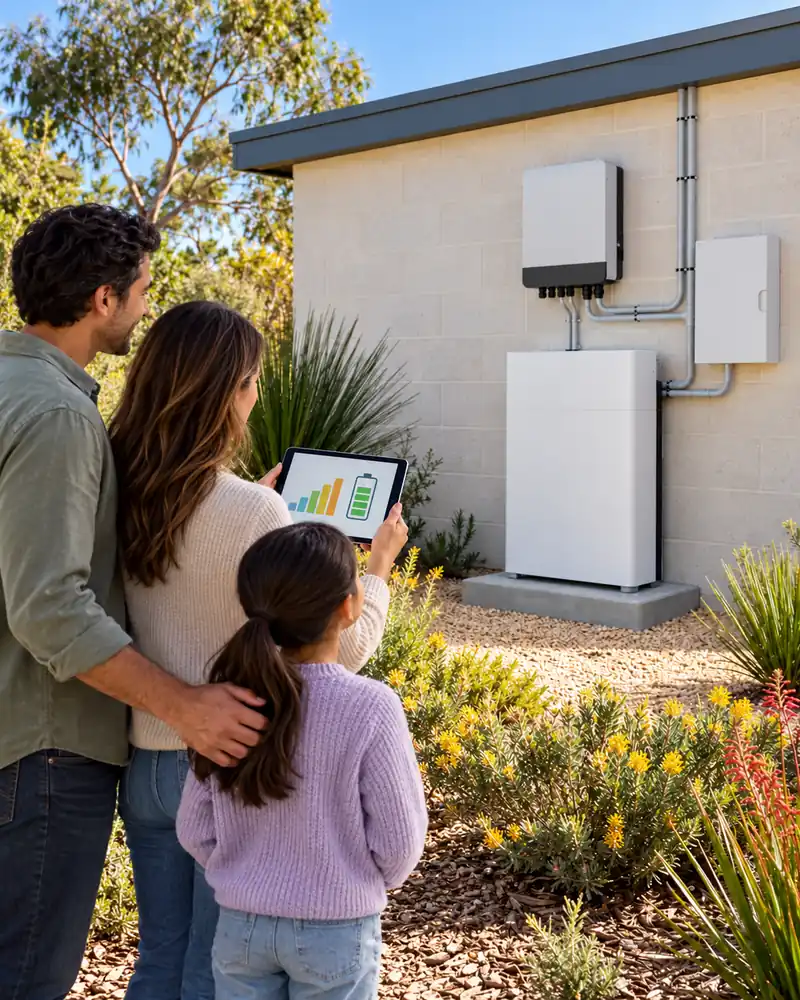
The federal solar battery rebate takes around 30% off the upfront cost of an eligible home battery. It is officially called the Cheaper Home Batteries Program, and it is delivered as a discount on your quote rather than a payment to you.
Two things changed on 1 May 2026. Support is now tiered by battery size, and the rate drops every six months. The next drop is 1 January 2027.
For solar panel certificates and state programs, see our full solar rebate guide.
How the Battery Rebate Is Calculated
- Around, an eligible battery
- 30%off
- Full rate applies up to
- 14kWh
- Minimum usable capacity
- 5kWh
The discount comes from small-scale technology certificates (STCs). The government buys the certificates created for each battery, and your installer passes the value on as a lower price.
The number of certificates depends on:
- Usable capacity of the battery, in kWh
- The STC factor, the number of certificates per kWh, which depends on the installation date
- The capacity tier each kWh falls into
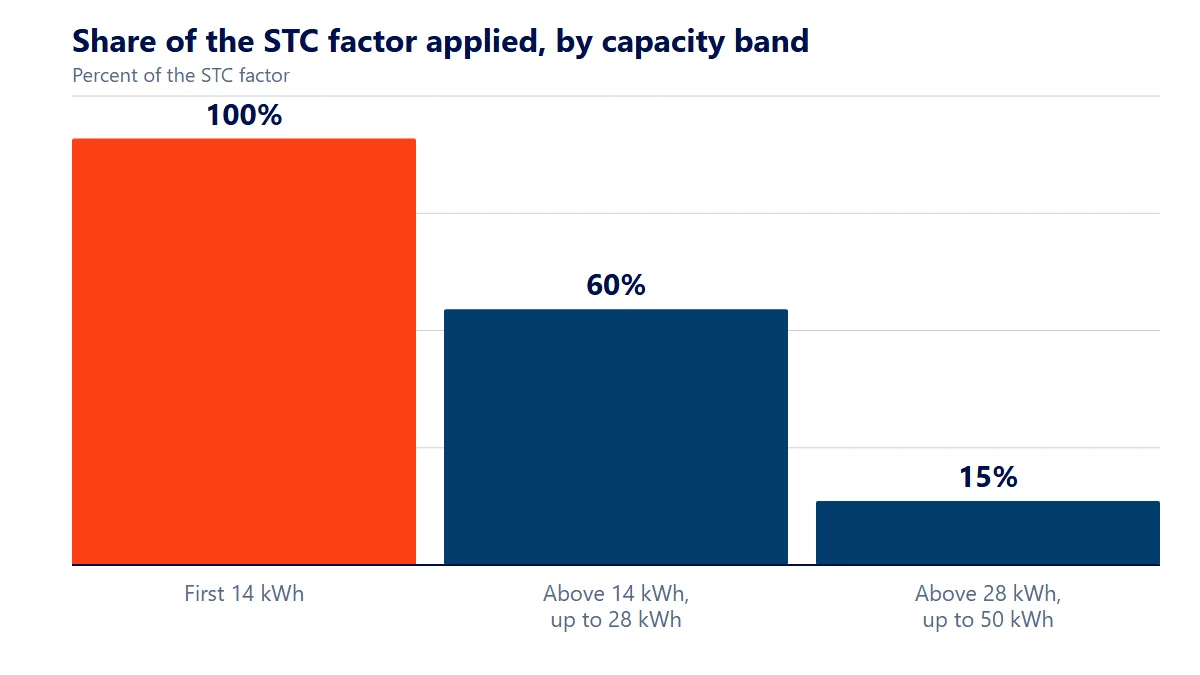
| Usable capacity band | Share of the STC factor applied |
|---|---|
| First 14 kWh | 100% |
| Above 14 kWh, up to 28 kWh | 60% |
| Above 28 kWh, up to 50 kWh | 15% |
| Above 50 kWh | No support (systems up to 100 kWh remain eligible) |
The Step-Down Schedule to 2030
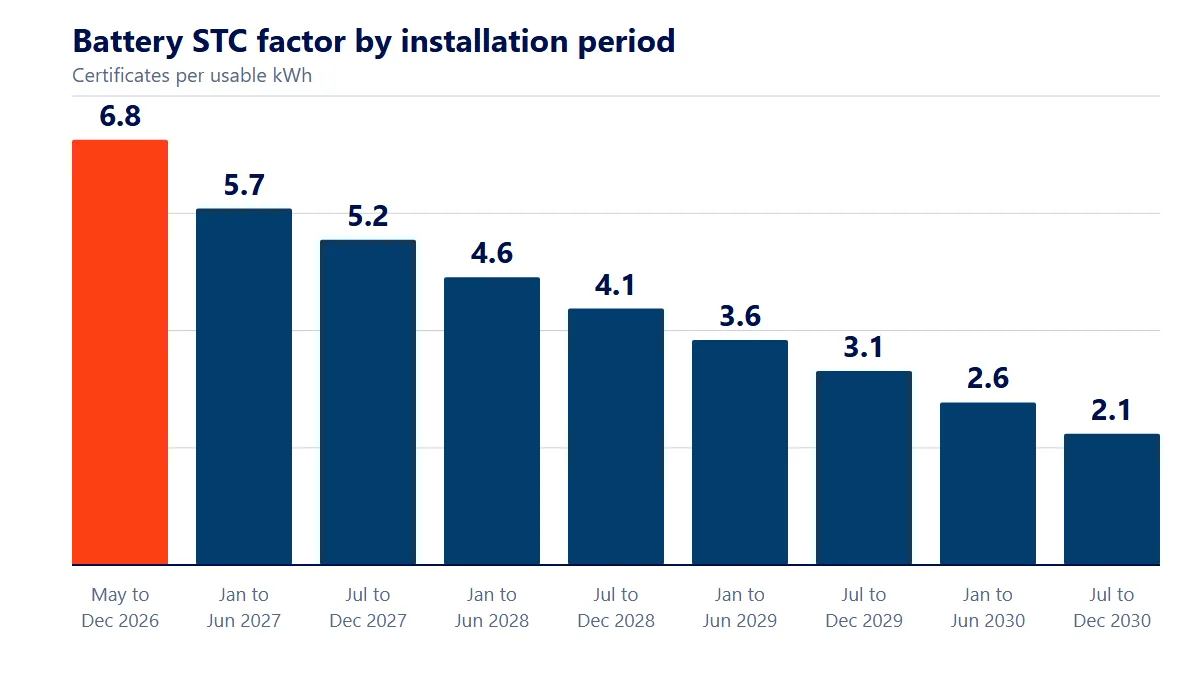
The discount is set by the STC factor on the day your battery is installed, not the day you sign.
| Period | STC factor (certificates per kWh) |
|---|---|
| May to Dec 2026 (current) | 6.8 |
| Jan to Jun 2027 | 5.7 |
| Jul to Dec 2027 | 5.2 |
| Jan to Jun 2028 | 4.6 |
| Jul to Dec 2028 | 4.1 |
| Jan to Jun 2029 | 3.6 |
| Jul to Dec 2029 | 3.1 |
| Jan to Jun 2030 | 2.6 |
| Jul to Dec 2030 | 2.1 |
Source: Clean Energy Regulator.
Worked Examples
The table shows certificates for common sizes, and the most they could be worth at the $40 clearing house price. Market prices are usually a little lower, so treat the dollar column as a ceiling, not a promise.
| Usable capacity | Certificates, installed by 31 Dec 2026 | Up to (at $40) | Certificates, installed Jan to Jun 2027 | Up to (at $40) |
|---|---|---|---|---|
| 10 kWh | 68 | $2,720 | 57 | $2,280 |
| 13.5 kWh | about 91 | about $3,670 | about 76 | about $3,080 |
| 20 kWh | about 119 | about $4,790 | about 100 | about $4,010 |
| 30 kWh | about 154 | about $6,170 | about 129 | about $5,180 |
Two patterns stand out. A battery at or under 14 kWh gets the full rate on every kilowatt-hour. Above that, each extra kilowatt-hour attracts much less support, so the case for a bigger battery has to come from your usage, not the rebate.
Find Out What Applies to Your Address
We list every incentive you qualify for and show how each one is calculated, in writing.
Estimate Your Battery Rebate
Move the slider to your battery's usable capacity and pick the installation period. The estimator uses the tiers and factors on this page.
- Certificates
- about 91
- Federal discount, up to
- about $3,670
- WA rebate
- $1,300
- Combined, up to
- about $4,970
Illustrative ceiling only, not a quote. The federal figure uses the $40 clearing house price and the factors in the table above; market prices are usually a little lower. WA amounts are as listed on this page and need confirming on the WA Government page before you rely on them. We confirm your exact entitlement in writing.
Who Qualifies for the Cheaper Home Battery Program
- Households, small businesses and community organisations
- New batteries with at least 5 kWh of usable capacity, in systems up to 100 kWh
- Batteries and inverters on the Clean Energy Council approved product list
- Installed by a Solar Accreditation Australia installer with battery endorsement
- On-grid batteries must be VPP-capable. Joining a virtual power plant is optional under the federal program.
- No income test applies to the federal discount
Adding a battery to existing solar is eligible. When that happens, the accredited installer must re-certify the whole system. See solar battery installation for how that works.
The WA Battery Rebate on Top of the Federal Discount
Solar battery rebates WA. The WA Residential Battery Scheme adds $130 per usable kWh for Synergy customers, capped at $1,300, or $380 per kWh for Horizon Power customers, capped at $3,800. The battery must be enrolled in an approved VPP and come from the retailer's supported list. Eligible households can also apply for a no-interest loan of up to $10,000.
Combined, for a battery installed by 31 December 2026:
| Usable capacity | Federal discount, up to (at $40) | WA rebate, Synergy (Perth) | Combined, up to |
|---|---|---|---|
| 10 kWh | $2,720 | $1,300 | $4,020 |
| 13.5 kWh | about $3,670 | $1,300 | about $4,970 |
| 20 kWh | about $4,790 | $1,300 | about $6,090 |
The WA rebate stops rising at 10 kWh, because it is capped at $1,300 for Synergy customers. Horizon Power customers in regional WA receive up to $3,800 instead. The federal column is a ceiling based on the $40 clearing house price; market prices are usually a little lower.
Perth homeowners can read how this works locally on our Perth page.
Find Out What Applies to Your Address
We list every incentive you qualify for and show how each one is calculated, in writing.
What the Cheaper Home Battery Program Subsidy Changes Mean for You
- Timing matters.A 10 kWh battery installed in December 2026 earns 68 certificates. The same battery installed in January 2027 earns 57.
- Installation date counts, not order date.Book early in the period if you want the current rate, and leave room for approvals.
- Size to your usage.The taper means oversizing now costs you more out of pocket than it did before May 2026.
- Do not rush a bad design.A well-sized battery installed a few weeks later usually beats a poorly matched one installed in a hurry.
Frequently Asked Questions
How Much Is the Solar Battery Rebate?
It depends on usable capacity and installation date. For a 10 kWh battery installed by 31 December 2026, it is 68 certificates, worth up to $2,720 at the clearing house price.
Does a 13.5 kWh Battery Get the Full Rate?
Yes. Every kilowatt-hour up to 14 kWh receives 100% of the STC factor.
Do I Have to Join a Virtual Power Plant?
Not for the federal discount, but the battery must be capable of joining. In WA, the state rebate requires VPP enrolment.
Do I Need to Apply Myself?
No. Your accredited installer creates the certificates and applies the discount to your quote.
Is the Program Ending?
It is scheduled to run until the end of 2030, with the rate falling every six months.
Can I Combine the Federal and WA Battery Rebates?
Yes. The WA Residential Battery Scheme is paid on top of the federal discount, as long as the battery is enrolled in an approved virtual power plant and meets the scheme's equipment rules.
Get Your Solar Battery Rebate Calculated
We will work out the exact certificates for your battery, add any state incentive and show it line by line in your proposal.